


PAGINA PARA MANTENER ELEMENTOS
"Google of money"
| Token | Typical fee | Speed | Energy use | Star use‑case |
|---|---|---|---|---|
| XNO | $0 | ~ 0.3 s | Tips / micro‑payments | |
| XLM | $0.000001 | ~ 5 s | Low | Fiat remittances |
| DASH | $0.001 | ~ 1 s | Medium | Retail payments |
| BTC (LN) | $0.0005 | ms | Low | Micro‑payments |
🔮 WAFFT Forward
👉 Stablecoins won’t just adapt—they’ll define the next era of money. Keep your eyes on Proof-of-Reserves, hybrid models, and AI innovations, and remember: Thanks to our WAFFT guide, you’ll gain the professional-grade finance skills you need—from stablecoin mechanics and DeFi strategies to regulatory deep dives. We’ll be right by your side on the path to wealth, supporting every decision and celebrating every milestone.
🏆 Stablecoins Section Complete!
You’ve now got a full, deep-dive masterclass on stablecoins under your belt. If you’re still hungry for more, flip to the next chapter: Payment Tokens, or fire up our "Google of money" search engine. Type in anything—from inflation and GDP to memecoins—and keep leveling up your investor IQ.
See you on the path to wealth, WAFFT-style! 
🤔 What Is Low Slippage?
📦[WAFFT Explains]
“Low slippage” means that when you exchange a large amount of one token for another, the actual execution price barely differs from the one you saw on screen before confirming the trade 📉💱.
💫 Simple Example:
- Imagine 1 USDe is worth 1 USDC in a liquidity pool.
- In a shallow pool, if you try to swap 10,000 USDe, you might end up receiving just 0.99 USDC per USDe — that's a 1% slippage 😬.
- On Curve, thanks to its design and deep liquidity, the same trade might execute at 0.9999 USDC per USDe — just 0.01% slippage 💧✅.
- The lower the slippage, the more reliable the price and the less value you lose when swapping — especially on large trades 🚀🔄.
👉 That’s why traders often prefer platforms like Curve for big swaps — better prices, lower losses.
🧘 WAFFT mantra:
"In crypto, ‘stable’ is just a slick algorithm… your skepticism is the real peg.”
We laid it out without confusing formulas—because knowing is the first step to owning the game!
That’s how we do it at WAFFT. 🧠💥
WAFFT Risk Score 🔥 3/5 — medium risk: audited reserves and credible PoR, but limited liquidity outside Asia and future issuance tied to Hong Kong licensing.
Visit the WAFFTguide for more insights like this and stay ahead of the curve.

🧠 WAFFT Data Insight:
“PoW burns energy like a Ferrari; PoS like a Tesla. Today, 73% of new payment-focused tokens use PoS or hybrid models (like Ethereum, which blends both).”
IMAGEN EDITADA LOS TAMAÑOS PARA EL ACORDEON (X ESO SE VE TAN GRANDE EN LA PANTALLA, PERO LOS TAMAÑOS ESTAN BIEN PARA EL ACORDEON) ⬇️
esta caja de WAFFT EXPLAINS va insertada en el acordeon de tipos de token ⬇️
Mento Reserve Explained 🏦
📦[WAFFT Explains]
The Mento Reserve is Celo’s on-chain “ballast tank” that keeps native stablecoins (cUSD, cEUR & cREAL) pegged to their target values. Here’s the nutshell:
The Collateral Pool 🏊♂️ (backing assets): a smart-contract–governed fund holds crypto assets (CELO, ETH, etc.) to back every stablecoin in circulation.
The Oracles 🕰️ (price feeds): decentralized data providers continuously update the on-chain value of the collateral.
The Stability Buffer ⚖️ (peg adjustment): if market swings threaten the peg, the reserve automatically buys or burns stablecoins—using the collateral as a shock absorber.
The Governance Controls 🗳️ (community oversight): CELO holders vote on which assets back the reserve, set minimum reserve ratios, and adjust protocol fees to keep everything rock-solid.
Because all adjustments happen on-chain and under protocol-defined rules, anyone can inspect the reserve’s health in real time.
🔗 Dive deeper into the mechanics in the official Mento Reserve documentation
esta TABLA va insertada en el acordeon de tipos de token ⬇️
| Network | Fee range | Mobile-first | Native stables | Star use case |
|---|---|---|---|---|
| CELO | < $0.001 | ✅ | cUSD, cEUR, cREAL | NGO aid / retail |
| XLM | ≈ $0.000001 | ✅ | External anchors | Fiat remittances |
| SOL (Pay) | ≈ $0.00025 | ❌ | USDC/SPL | High‑speed checkout |
| DASH | ≈ $0.001 | ❌ | None | Physical POS |
ACORDEON PARA UNA SECCION cuando tiene mucha informacion, con sus respectivos apartados
1. Issuance & Consensus ⛏️
How are they created, and who decides which transactions are valid?
✌️ There are two major methods for issuing and validating transactions:
🔹 Mined (Proof of Work / PoW):
• Like Bitcoin. Validators (miners) compete to solve complex mathematical puzzles. The first to solve it earns the right to add a new block and gets newly minted tokens as a reward.
⚡ Cost: high energy consumption.
🛡️ Security: very strong, but slow and expensive.
🔹 Staked (Proof of Stake / PoS):
• Like Solana or Avalanche. Validators lock up a certain amount of tokens (staking) to prove their commitment to the network. The more tokens you stake, the higher your chances of validating a block.
🔋 Cost: low energy consumption.
🚀 Speed: faster and cheaper transactions.
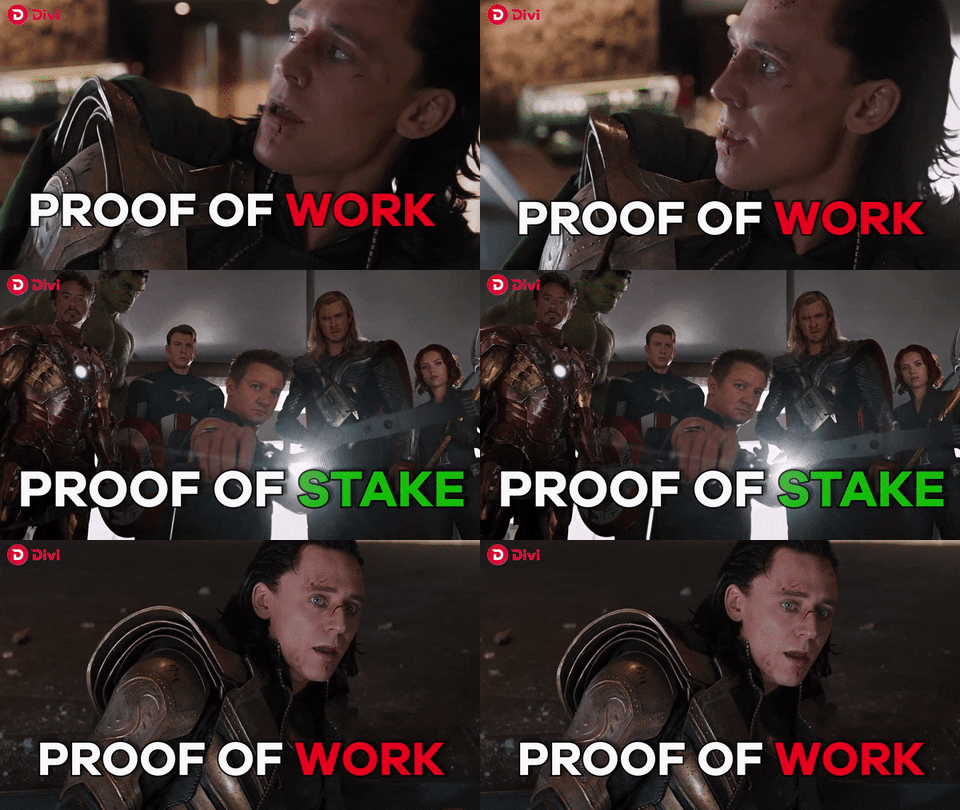
🧠 WAFFT Data Insight:
“PoW burns energy like a Ferrari; PoS like a Tesla. Today, 73% of new payment-focused tokens use PoS or hybrid models (like Ethereum, which blends both).”
2. Transactions & Verification ✅
Here’s how it works in 3 simple steps:
🖊️ Signature
Your wallet uses your private keys to “seal” the transaction. It’s like a digital stamp: it guarantees that only you have given the green light and that no one can forge it.
🌐 Propagation
The transaction enters the mempool (the “waiting room” where all pending operations sit) and, in milliseconds, spreads to thousands of network nodes—like a message you forward to everyone at once. Before you even pour yourself a coffee, thousands of nodes already know it.
🔒 Confirmations
Think of the blockchain as a stack of bricks. When your transaction enters the first brick (block), it’s “glued” in, but it could still come undone if someone messes with the foundation. Each new block stacked on top adds another layer of cement. The more blocks, the harder it is to remove.
- Bitcoin: To go to bed without worries, wait for 6 blocks—about 60 minutes. That secures your payment like a concrete wall.
- Fast networks (Avalanche, Solana): Their cement sets almost instantly; with just 1 or 2 blocks (seconds), your transaction is already sealed and museum-ready.
😎 WAFFT explains:
On Bitcoin you wait a bit for maximum security; on modern networks, your payment is nearly irreversible before you finish your coffee.
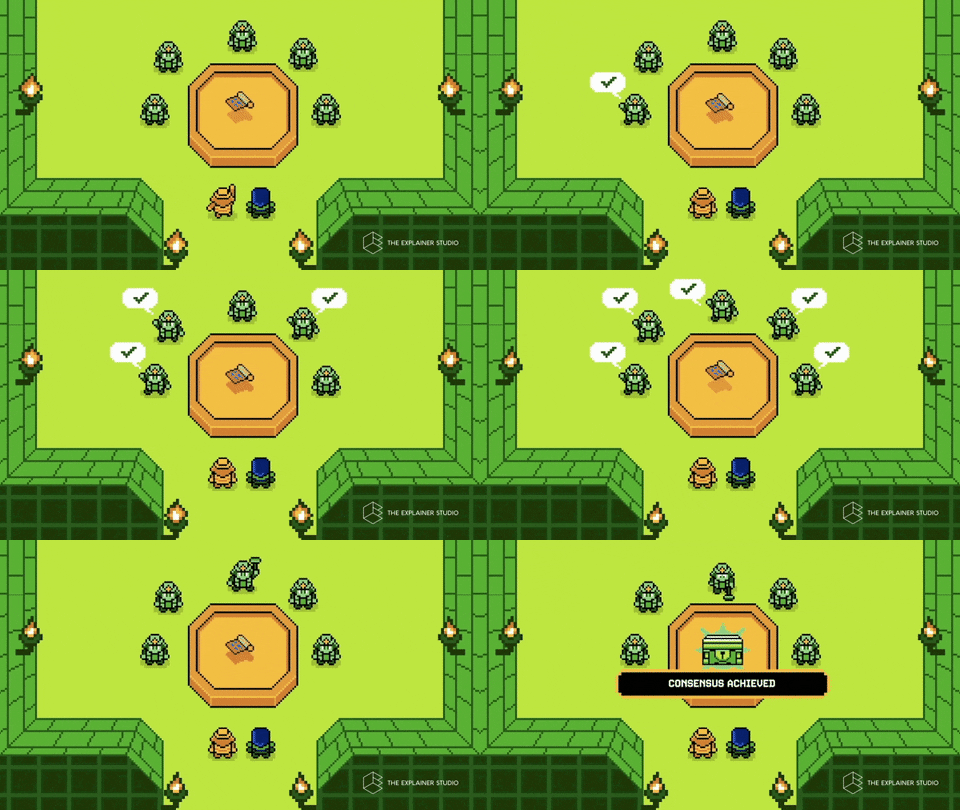
🔍 Real-Life Example
On networks like Solana (SOL), a transaction confirms in under half a second. Yes, you read that right—faster than a blink!
In contrast, on Bitcoin (BTC) you might wait up to 10 minutes for a confirmation.
And on Ethereum (ETH), each block takes about 12 seconds, but after about 12 confirmations it’s considered rock-solid.
✨ WAFFT Translation
Your payments confirm in real time, no weird delays, no mysterious cancellations, and with maximum security. This is money sent and done. 💸⚡
3. Scalability & Layers⚡
When your favorite blockchain starts going viral, bottlenecks show up: slow transactions, skyrocketing fees, and frustrated users. But fear not—there are multiple “layers” that help your crypto move faster than a rocket. 🚀
🔍 The Base Layer Problem
Bitcoin’s base layer handles only about 7 transactions per second (tx/s).
The result? During high demand, millions of users fight for space in each block, and fees shoot up like foam. 💸
So how do we fix it? Enter the “layers”...
| Layer | Token / Network | Approximate Speed |
|---|---|---|
| Lightning Network | Bitcoin (BTC) | ~1,000,000 tx/s |
| Solana Pay | Solana (SOL) | ~65,000 tx/s |
| USDC on Layer 2 | Polygon (MATIC) | ~7,000 tx/s |

Lightning Network (BTC): Off-chain payment channels that allow instant micro-transactions without clogging Bitcoin’s mainnet.
Solana Pay (SOL): A lightning-fast network with near-zero fees—perfect for mass payments.
USDC on Layer 2 (Polygon): Brings the world’s most popular stablecoin to a secondary layer, cutting fees and boosting speed.
🎯 WAFFTip
Buying a smoothie or a soda? Go with Lightning. Collecting an NFT? Use SOL or ETH on Layer 2 for fast and cheap transactions. 🥤⚡
✨ Bonus WAFFTip: Check out zk-Rollups (like zkSync or Polygon zkEVM) and Arbitrum—Layer 2 tech that lets you move assets on Ethereum with tiny fees and strong security.
Thanks to these scaling layers, your crypto experience levels up: faster speed, lower costs, and no more endless waits.
Less waiting, more winning. Welcome to next-gen payments. 🌐🚀
4. Fees: The Great Banking Lie 💸
Compare and cry, WAFFTer! 😭👇
Method | Sending $100 to Argentina | ⚡ Time |
|---|---|---|
| Traditional Bank | $12 + 3% markup | ⏳ ~3 days |
| Stablecoin USDC (Polygon) | $0.001 | 🚀 ~5 sec |
| Bitcoin (Lightning Network) | $0.0001 | ⚡ ~1 sec |
Banks charge you up to 50× more… just to be slower! Capitalist irony, bro. 🤯
🤔 Why such a big difference?
• Traditional banking: SWIFT fees, currency conversion, third-party intermediaries… and of course, their “just-in-case” margin.
• Stablecoins: Run on efficient blockchains (Polygon, Solana, etc.), with near-instant validation and laughably low costs.
• Lightning Network: An extra layer on top of Bitcoin that enables micro-payments at light speed without clogging the main chain.
🔍 Things You Should Know
Before you go all-in, keep these in mind:
Fees vary depending on network congestion and the exchange you use, but they’re rarely anywhere near traditional banking costs.
Fiat conversion: If the receiver needs cash (like pesos or dollars), there’ll be a small exit fee—still way lower than banks.
Regulation: Some countries still impose restrictions. Always check before sending to avoid surprises.
💥 Bottom line:
The old financial system charges premium prices for a horse-and-cart experience—while crypto moves at rocket speed. 🚀
Master these numbers and let WAFFT: The Path to Wealth show you how to ride them—without letting banks dig into your pockets. 💪🦊
5. Security & Censorship 🛡️
Why do Payment Tokens make governments and banks squirm? Because they turn you from a “tolerated user” into a sovereign owner of your own money.
🗝️ Private Keys | 🌐 P2P Networks | 🔍 Transparency |
|---|---|---|
| Your keys = your cash. No custodians → no freeze “on suspicion”—only you control your funds. | As long as at least one node is running (even in Antarctica 🐧), your transactions stay live. | Every move is permanently recorded on-chain—censoring without a trace is nearly impossible. |
🔥 Real-world examples
Nigeria, 2024: Government froze protesters’ bank accounts—but couldn’t touch their BTC wallets.
- Canada, 2022: Donations to truckers were seized in banks; crypto flows still went through.
- Belarus, 2020–: Activists received USDT donations to dodge state restrictions.
💡 Key points to know
1. Self-custody ≠ invincible: Lose your seed phrase? You lose your funds. Back it up securely in multiple locations.
2. Partial censorship exists: Centralized exchanges can block users under court order. True freedom is in non-custodial wallets.
3. Privacy ≠ total anonymity: Public blockchains are traceable. Use new addresses, legal coin mixers, or Layer‑2 networks to stay discreet.
4. Hardware wallets 🔐: For serious amounts—keep your keys offline and away from malware.
5. Stay updated: Keep your firmware and nodes current—don’t be the weakest link.
🏁 Final WAFFT Reminder:
“If your money depends on a banker’s signature, it was never truly yours. With Payment Tokens, your signature is the law.” 🤘
Master security and censorship-resistance, and you’ll unlock a financial superpower no bureaucrat can confiscate. Want more tricks? Head over to the WAFFT search engine—your "Google of money"—and find everything you need to shield your capital like a true crypto ninja. 🥷💸
Because whoever controls their security, controls their financial destiny. 🧠🔐
6. Interoperability: Bridges That Matter 🔗
Moving value between blockchains is no longer a leap of faith… if you pick the right highway. Here are a few solid options beyond the typical “wrapped token” gimmicks:
Solution | 🌐 What it does | ⚙️ Use case |
|---|---|---|
| Circle CCTP | Instantly “burns and mints” USDC across chains (burns on chain A, mints on chain B)—no custodial bridges. | Coinbase and Binance move USDC from Ethereum to Avalanche in minutes. |
| Solana Pay | Enables payments with SOL (or USDC on Solana) in online stores. | Shopify: you send SOL, the store gets USD instantly. |
| LayerZero | Omnichain protocol that connects networks like BNB, Avalanche, Arbitrum, etc. | NFT games that transfer items cross-chain with no friction. |
| Thorchain | “Cross-chain DEX” for native swaps (BTC ↔ ETH ↔ ATOM) without wrapped tokens. | Swap BTC for ETH directly, no centralized exchange needed. |
⚠️ WAFFT Alert:
Avoid unaudited bridges—billions in crypto have vanished in hacks. Speed means nothing if your assets vanish into thin air.
🛟 Tips for Crossing Chains Safely
1. Check audits and TVL: More liquidity = less slippage and greater trust.
2. Test with small amounts before sending your fortune.
3. Verify contract addresses: fake clones are everywhere.
4. Diversify bridges: don’t rely on just one—have a Plan B (and C).
5. No weird delays or sketchy pop-ups: legit bridges execute in seconds. If it lags, be suspicious.
6. Stay updated: trustworthy protocols publish security patches and audit notes regularly.

With the right bridges—whether it’s Circle CCTP’s instant burn-and-mint, LayerZero’s omnichain messaging, or Thorchain’s native cross-chain swaps—your funds glide through the crypto multiverse like the monkey from the gif above confidently crossing the bridge. 🐒😂
Want to keep up with the safest routes? Follow our socials and stay sharp with every WAFFT update. 🤘
WAFFT Take 🔥
Payment Tokens are ballistic missiles aimed straight at the heart of traditional banking: fast, precise, and asking permission from no one. 💥

▶️ Prioritize security: Use Bitcoin on-chain. It’s the most censorship-resistant network out there and nearly double-spend-proof. Yes, it’ll cost a bit more and take longer, but your transaction becomes almost indestructible.
▶️ Low-cost speed: Go with the Lightning Network (BTC in milliseconds) or Solana (fees are fractions of a cent). Perfect for microbpayments and instant transfers.
▶️ Global payments without volatility: Send USDC over a Layer 2 (Polygon, Base, Arbitrum…). You keep dollar value and pay cents to move it.
“Forget banks with 9-to-5 hours. Your money should move 24/7, borderless, and for pennies.
If not, it’s not really your money—because if you don’t control it, someone else does.”
🚀 Next Steps – WAFFT Style
• Send 10,000 sats (~€0.50) via Lightning and feel that instant ping.
• Pay for a coffee with Solana Pay or USDC and watch the merchant get paid instantly—no middlemen.
• Try sending a remittance with USDC via Polygon, compare it with your bank… then decide which one truly earns your trust.

Enjoy your financial freedom… and if it clicks, head back to your bank with a smile and wave goodbye to “maintenance fees.” 😎
Simple as that: adopt the money of the future today and show the elite that financial control has officially changed hands. WAFFT power! 🧠💸
🤔 What Are Lightning Channels?
📦[WAFFT Explains]
What is a channel? 🤔
A Lightning channel is a private payment lane between two nodes (for example, you and your supplier). It works like an open tab: you can swap funds instantly without touching the main chain each time.
Example → 🧋
A local bubble-tea shop and a regular customer open a channel for the day. The customer “tabs” each drink purchase off-chain—instantly and for free—and at day’s end they settle the net total on-chain in a single transaction.
How to open a channel ➡️
1. Both parties agree on an amount of BTC to “lock” in a multisig script (a special wallet setup that requires signatures from both parties).
2. You publish that funding transaction on the Bitcoin blockchain (this is on-chain and incurs fees).
3. Once confirmed, the channel is live: you can move funds back and forth by exchanging signed balance updates—no further on-chain transactions needed.
How to close a channel ⬅️
Cooperative close 🤝: Both parties exchange a final signed closing transaction and publish it on-chain, redistributing funds according to the last agreed balance.
Unilateral (force) close 🚨: If one party won’t cooperate, you can broadcast your latest signed state on-chain; it takes longer to finalize and usually costs higher fees.
In short, opening or closing a channel requires one on-chain transaction at the start and one at the end, while all intermediate micro-payments happen off-chain for free. That’s why if the base layer gets congested, opening/closing channels becomes more expensive.