


Stablecoins 💵

What Are Stablecoins? The WAFFT Guide to Crypto’s Steady Anchors

📜 Legal Framework: The U.S. GENIUS Act establishes a federal license for stablecoin issuers and confirms that regulated “payment tokens” (including stablecoins) are not securities—providing clear regulatory certainty and paving the way for broader stablecoin issuance and adoption across all blockchain ecosystems.
With this regulatory clarity, stablecoins are the key to navigating crypto’s choppy waters 🌊. Imagine the agility of a digital token you can move 24/7 anywhere in the world, paired with the near-fixed value of a reference asset—typically the U.S. dollar 💰. That’s exactly what stablecoins offer: token mobility plus price stability.
By pegging their value, stablecoins not only enable nonstop money movement but also underpin DeFi (Decentralized Finance) 🏦 and serve as a safe haven when Bitcoin (BTC) or Ethereum (ETH) volatility spikes 🎢.
Today, stablecoins are the "plasma" of the crypto system🩸: flowing through exchanges, lending protocols, and global payments 🌐. Even traditional banks like Société Générale are launching their own under regulatory frameworks such as MiCA 🏛️. Notably, Circle’s USDC—now boasting a market cap of over $61 billion—went public on the NYSE (NASDAQ: a major U.S. stock exchange focused on tech and growth companies) under the ticker CRCL when the company raised $1.05 billion and reached a valuation of $8 billion, further solidifying their role as the backbone of digital settlement. 🚀.
What Exactly Is a Stablecoin? 🤔
A stablecoin is a crypto asset designed to maintain a 1:1 (or very close) peg to an external asset—fiat currency (USD, EUR), commodities (gold), or even other cryptos. Its main goal: serve as a reliable medium of exchange and unit of account without the wild price swings of other cryptocurrencies.
Main Types & Their Mechanics ⚙️
| Model | Backing Mechanism | Examples | Quick Pros / Cons |
|---|---|---|---|
| Fiat-backed | Cash and T-Bills in banks, with monthly attestations. | USDC, USDT | + Highly liquid and easy to use / – Relies on custodians and regulators. |
| Crypto-backed | On-chain collateral (typically over-collateralized) in other cryptos. | DAI | + Transparent, no banks / – Liquidation risk if collateral crashes. |
| Commodity-backed | Gold or other precious metals held in vaults. | PAXG | + Tangible hedge / – Costly custody & logistics. |
| Algorithmic | No physical reserves; stability managed via smart contracts. | Frax (partial), TerraUSD* | + Capital-light / – Fragile; TerraUSD collapse forced redesigns. |
| Hybrid | Combines collateral reserves with algorithmic controls. | Emerging "reserve+algo" models | + More resilient / – Highly complex and experimental. |
💡 WAFFTip:
Always check the latest reserve attestations (e.g., Circle’s monthly reports at circle.com/usdc-reserve) and monitor real-time flows on dashboards like DeFi Pulse or Nansen before choosing your stablecoin.
How Do Stablecoins Work?
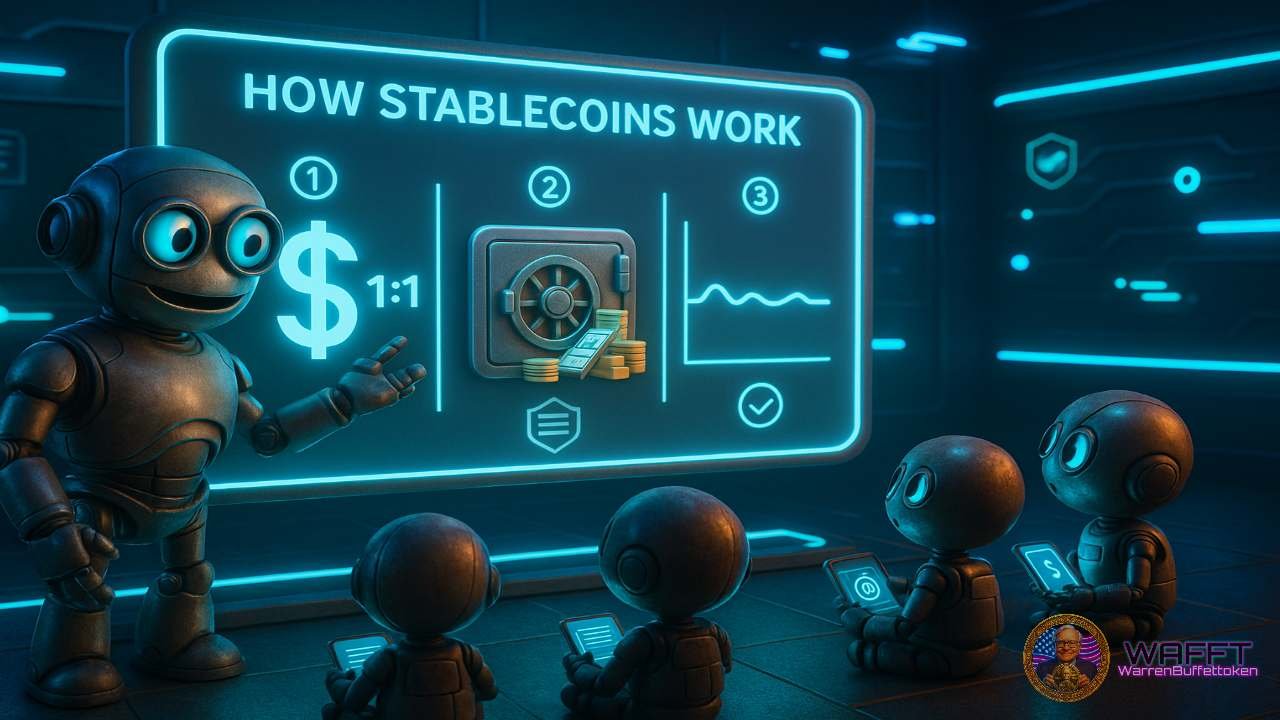
Imagine a financial chameleon 🦎: it can hop blockchains (Ethereum → Polygon → Solana) in seconds, adapting wherever you need it, but its color–price stays green at $1. No matter the terrain, its value holds firm.
🪄Its trick? Not magic, but a smart combo of four main engines working in harmony: real-world reserves, algorithms, arbitrage, and radical transparency. These pillars keep the stablecoin’s value promise rock-solid. 🏛️
🏛️ 1. Real-World Reserves

🌍 The “Peg” (Anchoring to Real Value)
The peg is the foundation. It’s the promise that your stablecoin is tied to a real-world asset. 🪙 → 💰
🔹 Key concept:
“1 stablecoin = $1 of physical asset (or gold/other promised asset).”
In theory, every unit of stablecoin is directly backed by a tangible or digital asset that gives it value.
🔹 Types of backing:
• Fiat-backed (USDC, USDT): dollars sit in a bank.
• Commodity-backed (PAX Gold): each token = a tiny slice of a gold bar.
• Crypto-collateralized (DAI): extra crypto is locked in smart contracts as over-collateral.
• Algorithmic/Hybrid (FRAX): partially backed, partially stabilized by code.
🔹Detailed mechanics of this anchoring:
| Type | How It Works | Everyday Example | ⚠️ Key Risk |
|---|---|---|---|
| 🏦 Fiat-backed | The issuer —company or foundation —stores $1 in a bank or ultra-safe instruments (like U.S. Treasury Bills) for each token minted and circulating. | Like leaving cash in escrow and getting a ticket you can redeem anytime for your deposit. | If the custodian bank collapses (e.g., SVB 2023) or assets aren’t truly 1:1, your funds could freeze or lose value. |
| 🔗 Crypto-backed | Users lock a larger amount of crypto (e.g., $150 of ETH) as collateral to mint $100 of stablecoins. | Think mortgaging your car (volatile asset) for quick cash. If the car’s value plunges, the lender sells it or demands more collateral. | If ETH plunges 40% in a day, automated bots liquidate your collateral to protect the peg, risking losses for you. |
| 🤖 Algorithmic | No direct reserve. Smart contracts mint or burn tokens to match supply with demand, keeping price at $1. | Like a smart thermostat tweaking heat/cool to hold a room at 22 °C without a physical energy reserve. | In panic sell-offs, the algorithm can fail and the peg collapses (e.g., UST 2022), wiping out value. |
| 🪙 Gold-backed | Each token represents a fixed amount of physical gold in secure vaults. The issuer must hold the gold for every token minted. | Like owning a paper certificate for gold stored elsewhere—you don’t have the bar, but you own it. | Real but illiquid: large sells can incur 3%+ discounts if buyers can’t be found quickly. |
⚙️ 2. Algorithms
🛠️ Stability Engines: The Survival Kit of Algorithms
Beyond backing, two key mechanics run nonstop to keep stablecoins pegged at $1:
✨ Mint & Burn (The “Token Printer” 🎟️)
· Mint: Deposit $1 (fiat or crypto equivalent); the issuer mints 1 stablecoin.
· Burn: Return 1 stablecoin; the issuer returns $1 (or collateral) and burns the token.
🎡 Like park tickets: enter → ticket prints; exit → ticket burns. Participants’ balances always match.
🆕 Beginner lens:
• Minting increases supply when demand rises, so price doesn’t shoot above $1.
• Burning shrinks supply when demand falls, so price doesn’t sink below $1.
It’s like adding or removing chairs so every player always pays exactly $1 for their seat. 🎯
⚡ Liquidation Bots (The “Airbag” Bots)
🔸 Only for crypto-backed assets:
Bots monitor collateral ratios; if collateral dips below safety (e.g., 130%), they auto-sell part of it—before the peg snaps.
Like an airbag deploying before a crash to protect you, these bots protect the stablecoin’s $1 value.
📦[WAFFT Explains]
What Are Liquidation Bots?
✩ Liquidation bots are on-chain programs (smart contracts) that check the vault’s collateral-to-debt ratio every block. When the ratio drops below a preset threshold (say 130 %), the bot automatically sends a transaction that sells just enough collateral—usually on a DEX or auction module—to repay the outstanding stablecoins and push the ratio back above the target level. This process is fully automatic, transparent, and doesn’t require any human intervention, ensuring the peg stays intact even during sharp market moves. 🤖📉
🆕 Risk note:
Liquidations can be noisy in the market. If collateral crashes too fast (e.g., March 2023 USDC bank scare), even bots may struggle, and a temporary de-peg can happen.
🤝 3. Arbitrage

🏪 Arbitrage (The “Price Correctors”)
If a stablecoin trades at $0.98, buy 100 for $98, redeem for $100 at the issuer → $2 profit.
Mass arbitrage pushes the price back to $1 (and vice versa for > $1).
Like snatching cheap concert tickets from sellers in a rush and reselling near face value—profit made, price normalized.
🆕 Plain English:
“Buy low on the market, sell high to the issuer (or the reverse).” Traders doing this 24/7 are the invisible hands that keep the peg tight. 🎫
🆕 Real example:
In May 2024 USDC briefly dipped to $0.995 on a DEX. Bots bought millions in seconds, redeemed with Circle, and pocketed small but near-risk-free gains—price popped right back up.
🔍 4. Radical Transparency

📋 Proof-of-Reserves (The “24/7 Auditor”)
Oracles and real-time audits verify 🔢 tokens in circulation vs. 💵 actual reserves.
Live dashboards (e.g., USDC Transparency at circle.com) let anyone confirm coverage.
💡 WAFFT Explains: For real-time stablecoin price tracking, check CoinGecko or DexScreener—your go-to dashboards for live market data and peg deviations.
🤹♀️ By the way, if you want to see WAFFT in action, check it out on DexScreener—live charts, raw data, no filters 👀📈
👉 And while you’re there, follow WAFFT on social media and join the sharpest minds in the cryptoverse. Catch you inside! 🚀🧠
🆕 Tip for first-timers:
• 🟢 Green checkmarks = fully backed.
• 🟠/🔴 Orange/red alerts = under-collateralized or slow audit updates—approach with caution.
⛽ Network Fees Reminder
Stable doesn’t mean free. Moving stablecoins on Ethereum Mainnet can cost $10–$20 in gas. Consider Layer-2 networks like Polygon or Arbitrum for sub-cent fees and near-instant settlement.
🆕 Heads-up:
• Each chain has its own version of a stablecoin(e.g., USDC.e on Polygon). Use official bridges to avoid fakes.• Always keep a bit of the chain’s native coin (ETH, MATIC, ARB) to pay fees—no gas, no move.
🗂️ WAFFT Selector: the stablecoin that fits you
| Type | For Whom | ✅ Advantage | ☠️ Key Risk |
|---|---|---|---|
| 🏦 Fiat | Beginners | Maximum stability & liquidity. | Bank risk (e.g., SVB) ; depends on custodian strength & regulation. |
| 🔗 Crypto | Decentralists | No central banks; full autonomy. | Auto-liquidations if collateral tanks. |
| 🤖 Algorithmic | Speculators | High-yield potential; total decentralization. | Death spirals or irreversible de -pegs if system breaks (e.g., UST) . |
| 🪙 Gold | Risk-averse | Tangible inflation hedge. | Limited liquidity; possible premiums/discounts. |
🎯 WAFFT Final Note
Stablecoins bridge crypto’s agility and fiat’s stability. But bridges collapse if…
Collateral is smoke 💨 (no real backing).
Liquidity vanishes ☀️ (no buyers to redeem).
You trust logos over audits 🔍.
✔ Your strongest weapon: demand live Proof-of-Reserves.
🛡️ Your best shield: diversify across multiple stables.
🧘 WAFFT mantra:
"In crypto, ‘stable’ is just a slick algorithm… your skepticism is the real peg.”
We laid it out without confusing formulas—because knowing is the first step to owning the game!
That’s how we do it at WAFFT. 🧠💥
Top Stablecoins & Their Use Cases
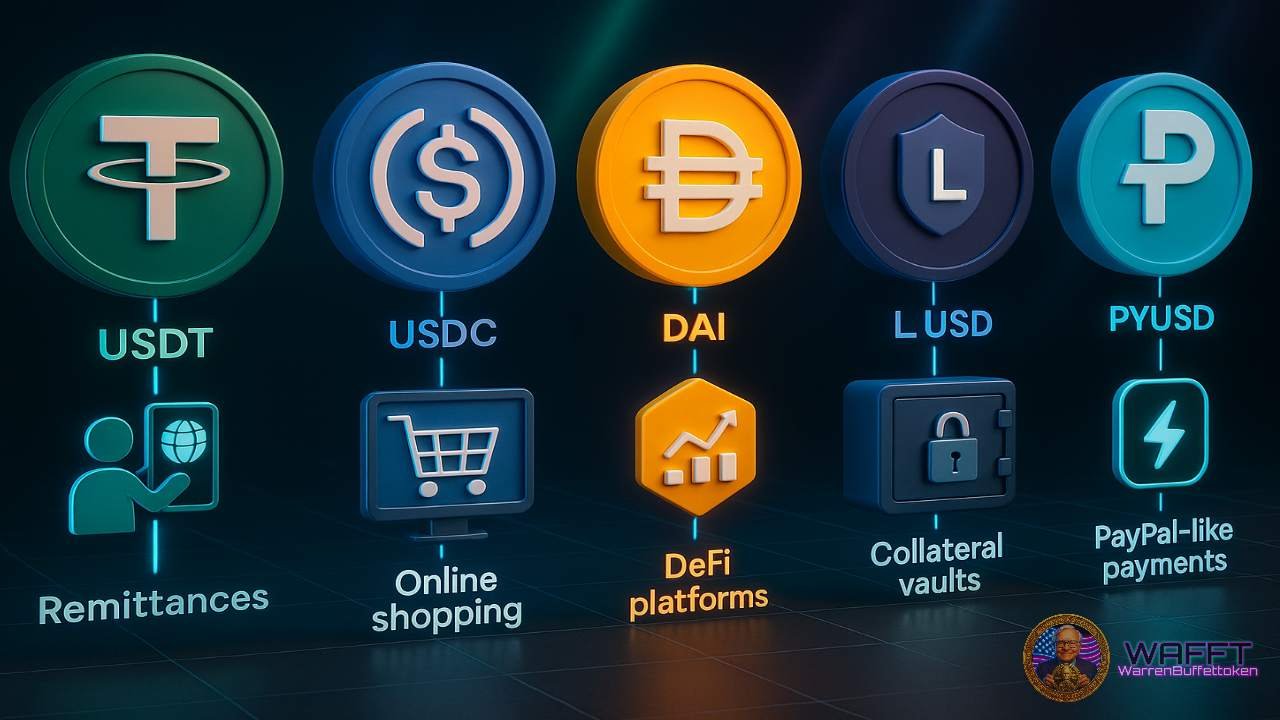
Not all stablecoins are created equal—some are sugar-coated, others are built for war. Below is a WAFFT-style deep dive into today’s most-used dollars-on-chain.
For every coin you’ll see how it keeps the $1 peg, the chains it lives on, the hidden risks, and exactly where it shines.
To keep things crystal clear, each profile ends with a WAFFT Risk Score on a 0-to-5 scale: 0 = “virtually no risk” 🛡️, 5 = “high risk—handle with care” ⚠️.
🔵 Fiat-Backed Heavyweights (Centralized)
USDC – Circle
🔹 USDC – Circle’s Regulated Dollar
Most USDC now circulates on 21+ networks—from Base and native Solana to Arbitrum and Polygon—so you can send the same dollar on whichever chain has the lowest fees. (Think “digital cash that hops highways at will.”) 🛣️⚡
official site: usdc.circle.com
✺ What backs each token?
Circle holds 100% reserves in short-term U.S. Treasuries and cash. Independent auditors (Deloitte) publish a monthly attestation showing every bond and bank balance—so for every USDC you see on-chain, there’s a dollar-grade asset parked off-chain. 🏦📜
✺ The SVB scare, translated
When Silicon Valley Bank collapsed in 2023, part of Circle’s cash got stuck for a weekend and USDC dipped to $0.87.
Lesson learned: Circle now diversifies across eight banking partners and keeps the bulk in Treasuries that can be sold the same day for dollars. 🛡️
✺ Why big players like it
• Institutional settlement: Visa, BlackRock, and PayPal have all piloted USDC payments to move dollars globally without waiting for SWIFT.
• MiCA-ready in the EU: Circle’s Dublin entity is structured to meet Europe’s new stablecoin rulebook, making USDC a go-to coin for “legal-by-design” DeFi and fintech apps.
• Programmable treasury: U.S. companies can mint/redeem directly via Circle Mint APIs—effectively using USDC as a 24/7 business checking account. 💼💸

✺ IPO signal
Circle listed on the NYSE. Why it matters: public reporting obligations add another layer of transparency—you can read their quarterly reserve disclosures just like any listed bank. 🏛️📈
✺ Reg-watch 👁️⚖️
Upcoming U.S. stablecoin legislation is expected to cap cash deposits per bank and mandate “live” reserve proofs. Circle states it is already aligned, but final rules could still reshape how (and where) USDC reserves sit.
WAFFT Risk Score 🔥 2/5 — diversified banks and daily liquidity, but it’s still a “banked” coin: no banks, no USDC.
USDT – Tether
🔹 USDT – Tether, the Liquidity Mammoth
✺ Everywhere, but especially Tron
Most USDT lives on Tron because transactions there cost fractions of a cent, while the rest sits on Ethereum, Solana, Avalanche, and another 10-plus chains. (Think “same dollar, different highways.”) 🌐⚡
official site: tether.to
✺ What’s behind each token?
Tether says it keeps “cash & cash equivalents” for every USDT: mainly short-term U.S. Treasuries and money-market funds.
Commercial paper (riskier IOUs) was fully retired in 2023. In plain English: ultra-short government debt that can be turned into dollars fast. 🏦
🤔 What’s This Thing Called “Commercial Paper”?
📦[WAFFT Explains]
Imagine a turbo-fast IOU issued by top-tier companies to patch liquidity gaps. Its DNA is simple:
Mini term ⏱️: ranges from 1–270 days; it lives in the ultra-short corner of the money market, right next to Treasury bills and certificates of deposit.
No collateral 👐: it’s unsecured debt—everything rides on the issuer’s rating and reputation.
Sold at a discount 💸: you pay less than face value and pocket the difference at maturity.
Quick example: you pay $990,000 today for $1,000,000 paper maturing in 90 days → at maturity you earn $10,000 (≈ 4% APR).
(APR stands for Annual Percentage Rate—the standard way to state, in annualized percentage terms, how much a loan or investment costs (or earns) when interest is not compounded during the year 📈.)
Who issues it 🏢: AAA/AA-rated corporates and banks that can afford to skip collateral.
Who buys it 💼: money-market funds, corporate treasuries and banks hunting for a yield premium over T-bills.
Perk for the company 🚀: covers payroll, inventory or any cash pothole without the hassle of a pricier, slower bank loan.
Key risks for the holder ⚠️:
Credit: if the issuer defaults, you’re paid late—or never.
Liquidity/roll-over 🔄: when it matures, the company must sell new paper to repay the old; if the market locks up, trouble starts.
Less liquid than T-bills 💧: exiting fast can cost you a steeper discount.
🌐 Why Does Crypto-Land Care?
When a stablecoin issuer stashes commercial paper in its reserves:
The peg becomes hostage to corporate credit risk (no 100% cash-quality).
Less transparency 🔍: issuer names and ratings aren’t always disclosed.
Roll-over roulette 🎰: if the market freezes, the reserves stop being liquid.
That’s why Tether flushed all its commercial paper in 2023 and replaced it with U.S. Treasury bills, far safer and more liquid.
WAFFT Bottom Line 🧠:
“More T-bills, fewer ‘I-owe-you’ slips. Stability isn’t collateral you can pawn.”
✺ Attestations ≠ full audit
An accounting firm (BDO Italy) publishes monthly attestation reports showing the reserve breakdown. An attestation is a snapshot, not a deep-dive audit—Tether hasn’t produced a full independent audit since 2017 and paid a $41 M CFTC fine in 2021 for “misleading reserves.” 🧐📜

✺ How redemption actually works
Big players (exchanges, OTC desks) can swap blocks of ≥ $100 k USDT for real dollars via Tether’s platform. Retail users typically convert on exchanges. This two-tier model keeps liquidity high but means direct redemption isn’t one-click for everyone. 💸↔️🏦
✺ Why traders and remitters love it
USDT dominates cross-exchange arbitrage (move dollars instantly between CEXs) and Latin-American remittances—Bitso Argentina reports ~50% of flows in USDT. For many abroad, it’s an offshore dollar hedge with 24/7 settlement. 🌎💱
✺ Reg-watch 👁️⚖️
Global watchdogs (FSB, FATF) and the EU’s MiCA rules will soon require stablecoins to hold reserves at regulated institutions and provide real-time proofs. If Tether can’t tick those boxes, some venues may restrict it.
WAFFT Risk Score 🔥 3/5 — unrivalled liquidity, lingering opacity.
RLUSD – Ripple
🔹 RLUSD – Ripple’s Cross-Border Dollar
Think of RLUSD as a digital pallet of cash: you shoot it through Ripple’s remittance rails and it lands as spend-ready dollars in ≈ 3-5 seconds on the XRP Ledger (XRPL). Unlike volatile crypto, each RLUSD aims to stick to $1, becoming a go-to bridge asset for payrolls, exchanges, and global payments that need speed without price risk.
official site: https://ripple.com/stablecoin
✺ Native on XRPL and Ethereum
It lives on the fee-pennies XRPL and on Ethereum for DeFi access, with more EVM chains in the queue. (Heads-up: main-net ETH gas is still pricey, so most users bridge RLUSD to Layer-2s for extra-low fees.)
✺ Classic fiat backing
Every token maps 1-for-1 to dollars in segregated accounts, reinforced by short-dated U.S. Treasuries. If 500 M RLUSD circulate, $500 M in cash + T-Bills back them.
✺ Regulated custody & monthly attestations
Funds sit at Standard Custody & Trust—a New York DFS-chartered digital-asset custodian built to “bank-grade” standards—and an independent auditor signs a monthly report proving reserves = tokens.

✺ Real-world use cases
• SBI Remit (JP ↔ PH) already settles remittances in RLUSD inside Ripple Payments.
What’s happening under the hood? SBI Remit—Japan’s largest money-transfer house—converts yen to RLUSD, zips it across the XRP Ledger in under 30 s, then pays out Philippine pesos on the other side. The all-in fee is about 0.8% versus roughly 5% on SWIFT, and the cash lands the same day instead of 2–3 banking days. 🌏💸
• On/off-ramps: partners like Alchemy Pay swap fiat ↔ RLUSD so merchants get instant dollars.
• Retail liquidity: traded on Bitso, Uphold, and Bitstamp, letting market makers arbitrage any peg drift.
Why it matters: deep order books on these exchanges let bots scoop up RLUSD at $0.99 and sell where it prints at $1.00+, nudging the price back to parity. That nonstop ping-pong keeps the peg tight and gives everyday users easy exit ramps. 🔄💱
✺ Pros vs. cons ⚖️
• Microscopic XRPL fees (fractions of a cent).
• Enterprise rails let banks plug in quickly.
− No yield to holders — Ripple keeps T-Bill interest.
− Freeze risk — tokens can be halted on legal orders.
✺ Reg-watch 👁️🗨️
Upcoming EU MiCA rules and pending U.S. stablecoin bills may demand extra disclosures; Ripple says it will align with any 100%-reserve standard.
WAFFT Risk Score 🔥 2/5 — top-tier audits and corporate rails, but you’re still tied to custodial banking and permissioned controls. (Too much oversight for some—but hey, your money, your rules.)
PYUSD – PayPal
🔹PYUSD – PayPal’s Retail Warrior
✺ Chain Access & Reach
This stablecoin links traditional payments to the crypto world: live on Ethereum and Solana, with Stellar waiting in the wings for a regulatory green light.🟢
🌐 Network Coverage: Live nodes already clear 150 K+ PYUSD transfers per day, and PayPal has signaled an auto-bridge to Base once on-chain liquidity crosses its safety threshold.
Official site: https://www.paxos.com/pyusd
✺ 1:1 Fiat Reserves
It’s backed 1:1 by cash and short-term U.S. Treasuries—segregated in Paxos Trust accounts and audited monthly—so the footing is rock-solid 🪨
🏦 Reserve Transparency: With monthly BDO-signed PDFs and a real-time dashboard showing cash and T-bill breakdowns, always look for the green “Fully Reserved” badge — it's your signal that funds are fully backed before jumping in.
✺ Native Yield Edge
Its secret weapon? 3.7% APY, paid daily in PYUSD (🇺🇸-only) 🤑—out-yielding rivals like USDC or USDT that offer no native return.
📈 Yield Explained: The rate floats with 4-week T-bill auctions, so payouts shrink if the Fed eases—but still beat the 0 % most checking accounts pay.

✺ Merchant & User Utility
For merchants, its Shopify + PayPal Checkout integration makes it spendable like digital cash 🛍️; for PayPal/Venmo’s 400 M+ users, it enables instant crypto-fiat swaps ⚡🌎
🛒 Real-World Pay Case: Early pilots show a 20% lift in checkout conversion: no FX shocks, no hidden card fees, just click-to-settle dollars.
✺ Regulated Safeguards 🔒
Paxos can freeze assets when served a lawful order—an institutional safety net that protects users from fraud, even if it limits absolute censorship-resistance.
Ethereum’s gas fees remain steep, but they deter spam and should ease once Stellar’s ultra-low-cost rails go live.
Meanwhile, Solana already processes transfers for under US $0.002, and wallet support is catching up quickly.
Finally, on-chain “frozen” tags for sanctioned addresses add regulatory transparency without touching compliant accounts, smoothing the path toward broader adoption.
🫢 And yes, all this may run against WAFFT’s gospel of total financial freedom, but we’re still here serving up pure reality and good vibes—elite approval not required 😎✌️.
WAFFT Risk Score 🔥 1.1/5 — PayPal rails and juicy variable yield, but mint/burn and freezes are 100% permissioned—regulators hold the kill-switch.
FDUSD – Binance
🔹 FDUSD – Binance’s Fee Killer
✺ Cross-Chain Supply
A multi-chain supply 🛠️ lives natively on BNB Smart Chain and as a wrapped ERC-20 on Ethereum; Stellar support is pencilled in once regulators give the nod 👮♂️.
Official site: https://firstdigitallabs.com
✺ Daily-Attested Reserves
Reserves—cash plus short-term U.S. T-Bills 💵—are attested daily by KPMG 📝 and published on First Digital’s Hong Kong dashboard.
✺ 24-Hour Reimbursement after Exploit
A $2.3 M hot-wallet exploit 🐞 (Aug 2024) was reimbursed in <24 h, cementing user trust and FDUSD’s role in Binance zero-fee BTC/ETH pairs, Binance Pay cross-border payouts 🌍, and PancakeSwap farming pools 🌾.
✺ Liquidity Consolidation
In 2025 Binance retired minor FDUSD pairs 📊 to consolidate liquidity, yet flagship volumes still dwarf BUSD’s final days.
✺ DeFi & Card Expansion
The token is also now accepted as collateral in Venus Protocol 🚀 and slated for Binance Card 💳 top-ups.
✺ Regulatory Radar
Regulators are circling 👁️🗨️: Hong Kong’s upcoming Stablecoin Ordinance 🇭🇰 will require First Digital to secure an FRS licence 📜 before it can keep minting from its HK base.

WAFFT Risk Score 🔥 2/5 — audited reserves & exchange-wide utility, but liquidity is Binance-centric and future minting hinges on upcoming HK licensing.
TUSD – Techteryx
🔹 TUSD – The Oracle-Verified Stable
Think of TUSD as a live-audited digital dollar anyone can check on-chain—swap a buck, get a token, and see the backing update in real time.
✺ Multi-Chain Presence
Lives natively on Ethereum, Tron, and BNB Smart Chain. More EVM-compatible networks (EVM = Ethereum Virtual Machine) will join once the regulatory framework allows it.
✺ Real-time Proof-of-Reserves (PoR)
Chainlink oracles publish live balances of cash + T-Bills—fully redeemable 1:1 for USD—custodied by TrustToken (HK) and audited monthly by an independent third party.
✺ Controlled Issuance Pause
Issuance was halted during 2023-24 to reinforce KYC and security; new tokens are minted only after those checks.
✺ Asia-centric liquidity
OTC desks in Korea and Japan handle large tickets, and daily exchange volumes often sit in the tens of millions of USD, while liquidity is thinner elsewhere.
✺ Exchange & DeFi Integrations
Listed on Binance, Huobi, and Bitfinex; used as collateral on Venus (to take DeFi loans with your TUSD) and JustLend, plus payment gateways that let merchants accept TUSD and receive USD instantly.

✺ Freeze & Redemption Facts
• Freeze authority — what it means 🔐
Like most regulated stablecoins, TUSD’s smart-contract carries an admin key that can blacklist an address whenever a court order or sanctions notice appears. A frozen wallet can’t move its TUSD (though it can still receive tokens), and the block lifts once the legal issue is settled. Think of it as a compliance kill-switch that targets bad actors without touching everyone else.
• How 1-for-1 redemption works 🏦
1️⃣ Create / log in to your verified account on the TrueUSD portal (Prime Trust) and pass KYC.
2️⃣ Add your bank details — the bank name must match your portal profile.
3️⃣ The portal shows a unique redemption address. Send the TUSD you want to cash out; the portal displays a dynamic minimum that can change over time 🧾, so always double-check before sending.
4️⃣ The smart-contract burns the tokens and triggers a USD wire transfer to your bank, usually within 1–2 U.S. business days (international wires can take a bit longer ⏱️).
5️⃣ Track the payout under “Redemptions” inside the portal.
Step-by-step guide: https://trueusd.zendesk.com/hc/en-us/articles/-How-do-I-redeem-TrueUSD
✺ Regulatory Incidents
• Sept 2024 — SEC action: U.S. regulators found a slice of TUSD’s backing sitting in a risky fund, clashing with its “100% cash-backed” claim. TrustToken paid ≈ $163 k in penalties 💰, shifted all reserves back to cash + T-Bills, and added quarterly third-party audits 🔍—all while keeping its live Proof-of-Reserves (PoR) feed running.
Lesson: when backing drifts, regulators pounce—but PoR lets holders verify reserves in real time.
✺ Regulatory Outlook
Hong Kong is drafting a Stablecoin Ordinance that will require an FRS licence (Fully-Reserved Stablecoin, the new HK framework) for TrustToken before it can keep minting from its HK base.
WAFFT Risk Score 🔥 3/5 — medium risk: audited reserves and credible PoR, but limited liquidity outside Asia and future issuance tied to Hong Kong licensing.
🟢 DeFi-Natives (Crypto-Backed & Algorithmic)
frxUSD – Frax Finance
🔹 frxUSD – Frax Finance’s Router Dollar
✺ Native issuance & bridging
Lives on Ethereum and Fraxtal (Frax’s own low-fee Layer 2) and is issued by the Frax Finance DAO 🌐🦄 — mint frxUSD 1-for-1 by depositing USDC (or another accepted stable) in the Frax app.
(official site: https://frax.finance).
Bridged copies on Arbitrum, Optimism and Sonic travel via Fraxferry, the protocol’s native bridge, but the canonical redemption stays on Ethereum mainnet or Fraxtal.
✺ Collateral security
Fully collateralised with regulated, dollar-denominated assets 🏦🔒 — every frxUSD is backed by tokenised U.S. Treasury bills (via BlackRock’s BUIDL fund) and high-grade stables like USDC, all held by qualified custodians and visible on-chain. No bank accounts or fractional algorithms: if markets froze, Frax could unwind Treasuries and USDC to redeem every frxUSD one-for-one.
✺ Effortless yield
Built-in yield without staking 📈💸 — thanks to Frax’s “AMO” market-making strategies plus Fraxferry reward emissions, simply holding frxUSD in your wallet earns ~7% APY (rate fluctuates with market conditions)—roughly $7 a year for every $100 if the rate stayed constant. The protocol routes pool fees back to holders automatically; no extra clicks. No staking, no claiming — just hold and earn.
✺ Official portal
👉 Learn more or interact directly on the Frax frxUSD official page 🌐.

✺ Key risks ⚠️
Although frxUSD is fully fiat-backed, it relies on custodians and the tokenised T-bill issuer; a freeze or regulatory hit could halt redemptions.
Liquidity outside the Frax silo is thinner: Uniswap v3 and Binance show only $2–3 million depth versus >$200 million for USDC, so very large exits may incur more slippage.
Extras & Advanced Mechanics
✺ Plug-and-play collateral for Fraxtal and Curve
How it works on Fraxtal: connect your wallet to the Fraxtal network, deposit frxUSD into Fraxlend (the lending market built by Frax), and the dApp lets you borrow WETH—wrapped ETH—against it.
Many users then sell that WETH for more frxUSD, stake it, and repeat the loop, so the same dollars keep earning yield multiple times.
You can track your health factor in the UI; if it drops too low, part of your position gets liquidated to keep the system safe.
How it works on Ethereum: instead of lending, you add frxUSD to the Curve frxUSD/USDC pool. Curve pays you trading fees whenever someone swaps between the two coins, and on top of that you receive CRV and CVX reward tokens each day.
Because the pool already holds $70 million+ in liquidity, even a trade of $100,000 moves the price by less than 0.1%, so you lose almost nothing to slippage when entering or exiting.
✺ sfrxUSDturns your frxUSD into a passive “savings bond”
open the Frax app, click Stake, and deposit (say) 100 frxUSD; the contract locks those dollars and sends 100 sfrxUSD back to your wallet as a receipt token. Behind the scenes, your frxUSD sits in the Treasury-bill strategy (earning the U.S. T-bill yield, ~4-5%) and farms extra CRV/CVX rewards from Curve, so the combined return averages ~9–11% APY.
Rewards auto-compound: each sfrxUSD gradually becomes worth more frxUSD over time—if rates held steady, 100 sfrxUSD might redeem for roughly 103–105 frxUSD after a year. You can unstake whenever you like with a single transaction; there are no lock-ups or penalties—just the Ethereum gas fee.

✺ Frax governance & FXS buybacks
Frax has its own token, FXS. Think of FXS as a share in the protocol’s future earnings: whenever frxUSD (or other Frax products) make more money than the yield they’ve promised users, the surplus is used to market-buy FXS on exchanges and instantly burn (destroy) it. Fewer tokens in circulation = each remaining FXS represents a bigger slice of the pie, which can lift the token’s price over time.
Holders of FXS can also vote on settings—like how much collateral the system should keep or which new chains to launch on—by signing on-chain proposals in the Frax governance portal.
You don’t need FXS to use frxUSD, but owning some lets you steer the protocol and benefit when its stablecoins grow.
✺ Roadmap 🛣️ What’s coming next?
• Aave v3 “Sonic” on Fraxtal: you’ll soon be able to drop frxUSD into Aave’s new ultra-fast pool and borrow WETH, wBTC, or more frxUSD with near-zero gas—same Aave interface, cheaper fees.
• Direct fiat on/off-ramps via FinresPBC: instead of first buying USDC, you’ll wire dollars (or use a debit card) and receive frxUSD straight in your wallet—and cash out the same way—making entry and exit as simple as a bank transfer.
• PayPal PYUSD plug-in: merchants already using PayPal will be able to settle in frxUSD behind the scenes, so you could pay with PayPal at checkout while your on-chain wallet still gets stablecoins.

🔸 All three items are in community governance discussion; timelines and final parameters will be posted in the Frax governance forum (https://gov.frax.finance) once proposals pass.
WAFFT Risk Score 🔥 3/5 — robust collateral and clear mechanics, but ecosystem reliance limits exit routes.
DAI – MakerDAO
🔹DAI – MakerDAO’s RWA Powerhouse
✺ Multi-chain reach
Works natively on Ethereum and moves seamlessly to Arbitrum, Optimism, Base, Polygon, and other roll-ups, delivering near-zero-fee swaps across the entire DeFi ecosystem. 🌐⚡
official site: https://makerdao.com
✺ Collateral mix
Collateral mix blends crypto vaults (ETH, wstETH, wBTC) with a growing slice of tokenised U.S. Treasuries and short-term bonds (Real-World Assets, RWA) held by regulated custodians through Maker’s Monetalis and BlockTower structures. 🏦🔗
✺ Auto-compounding savings (DSR)
The Dai Savings Rate (DSR) auto-compounds ~5-7% APY, funded by RWA yield plus stability fees—no lock-ups, exit any time. 💸📈
✺ Peg Stability Module (PSM)
The Peg Stability Module (PSM) lets users swap USDC ↔ DAI 1:1 for a tiny fee, absorbing peg pressure during market stress. ⚙️🛡️
✺ Rapid governance
MKR holders (the people who own Maker’s governance token) can vote to change key settings—literally overnight. A recent example was the debate over whether to accept Starknet assets as collateral. Looking ahead, Maker’s “Endgame” blueprint plans to spin off smaller, specialized “SubDAOs” and launch a new, low-fee blockchain (think “Solana-style”) to make using DAI cheaper for everyone. 🗳️🚀

✺ Ecosystem integration
DAI is woven into almost every corner of crypto and even everyday payments: on lending platforms like Spark, Aave, and Compound you can deposit it as collateral to borrow other assets, while checkout services such as Coinbase Commerce and BitPay let online stores accept it just like cash. Payroll apps built on low-fee Layer 2 networks use DAI to send salaries worldwide in seconds, and—in Europe—Monerium’s card rails can instantly convert your DAI into an IBAN balance so you can spend it anywhere that takes euros. 🔗💳
✺ Regulatory radar
Because part of DAI’s backing sits in U.S. Treasuries, American regulators like the SEC and FSOC keep a close eye on MakerDAO 👁️. On the European side, the new MiCA rules will force Maker to show exactly which real-world assets (RWAs) are backing the stablecoin. To stay ahead of that scrutiny, Maker now releases detailed, third-party attestation reports every quarter, so anyone can verify the reserves for themselves. 📜
WAFFT Risk Score 🔥 2/5 — rock-solid peg and yield from real bonds, but RWA brings regulator glare and swift governance tweaks can surprise holders.
USDe – Ethena
🔹 USDe – Ethena’s Synthetic Dollar
✺ Native issuance & bridging
Lives on Ethereum and is issued by Ethena Labs 🌐🦄 — mint USDe directly in the Ethena dApp; bridged versions on Arbitrum, Optimism and TON are IOUs, while true redemption stays on mainnet.
official site: https://www.ethena.fi
✺ Delta-neutral strategy
the protocol holds stETH (staked ETH that already earns ~3-4% staking yield) and opens an equal-sized short position in ETH perpetual futures; the long and short offset each other so USDe doesn’t care whether ETH pumps or dumps, while the staking yield plus funding fees power the returns.
✺ sUSDe staking
Deposit USDe into Ethena’s staking module and the contract locks it in the delta-neutral engine, minting an equal amount of sUSDe as your receipt token. While you hold sUSDe, the underlying USDe keeps earning two streams at once:
(1) the 3-4% staking rewards that stETH generates and
(2) the variable funding fees (historically 6-10%) paid to short-position holders on perp exchanges.
Both streams auto-compound, so the value of each sUSDe slowly rises against plain USDe. You can move or use sUSDe in other DeFi apps, and whenever you’re ready you simply burn it to withdraw your original USDe plus the accrued yield. Rates float with market funding, so returns can rise or fall from day to day, but there are no lock-ups or cooldown periods.
✺ Funding flips risk
Yield from perps comes from funding fees: when markets are bearish, longs pay shorts (the protocol collects); if sentiment flips bullish, shorts must pay funding. Picture this: shorts were earning +8% APR yesterday, but today they’re paying –3%—an 11% hit to your APY (annual percentage yield) until rates drift back toward zero.

✺ yield loops & delta-hedging
🔸 Yield loop: connect your wallet, deposit sUSDe as collateral on a lending market that supports it (e.g., Aave or Morpho), borrow ETH (up to ~60-70% of your deposit), swap that ETH back to USDe, stake it to mint more sUSDe, and repeat.
💫 Example: start with 1,000 sUSDe, borrow $600 in ETH, swap → stake, and you’re now earning yield on 1,600 sUSDe instead of 1,000. Keep an eye on the platform’s health factor: if ETH spikes or sUSDe falls and your loan-to-value breaches the safety line, the protocol can liquidate part of your collateral.
🔸 Delta-hedge: if you just want to stay price-neutral, hold USDe (or sUSDe) and open an equal-sized short on spot ETH or a perp; gains and losses on ETH cancel out while you still pocket the yield. Everything happens on Ethereum mainnet, so each loop costs gas—worth it mainly for larger positions.
✺ Deep liquidity & redemption
Liquidity runs deep on CEXs (Binance, Kraken) and on Curve’s USDe-FRAXBP pool, but the guaranteed $1 exit—redeem USDe for $1 in stETH—only works on Ethereum mainnet. To redeem, connect your wallet in the Ethena app, select Redeem, sign the tx, and receive stETH on chain. Bridged USDe on Arbitrum/Optimism must return to mainnet first.
Extras & Advanced Mechanics
✺ Trading & redemption
you can trade USDe for USDT, USDC, or fiat on Binance, Bybit, Kraken, or swap in the USDe-FRAXBP pool on Curve; even a $1,000,000 order usually shifts the price by <0.1% because market-makers keep the books thick.
If you want the guaranteed $1 exit, head to Ethena’s on-chain “Redeem”:
connect your wallet on mainnet → select Redeem→ sign the transaction → receive stETH, which you can later swap 1:1 for native ETH via Lido or secondary markets.
This route is mainnet-only, so bridged USDe on Arbitrum or Optimism must be sent back first, and each redemption costs gas (typically $5–10).
Holding USDe on a CEX? Either withdraw to an Ethereum wallet for on-chain redemption or just sell it directly on the exchange.

✺ All-crypto collateral
Every USDe is backed entirely on-chain by crypto you can verify yourself: stETH (staked ETH earning ~3–4% staking rewards), straight ETH, wrapped BTC, highly liquid stablecoins such as USDC, and a matching short-ETH futures position that neutralises price swings.
Because there are no bank accounts or real-world assets involved, nothing can be frozen by a custodian; all reserves sit in smart-contracts you can inspect on Etherscan or by opening Ethena’s “Reserves” dashboard. When the market moves, Ethena’s bot automatically tops-up or trims the futures so the net exposure stays close to zero, keeping USDe fully collateralised at all times.
✺ Key risks ⚠️
Heavy reliance on derivatives venues means a funding flip or exchange outage could hammer yields or unwind hedges; smart-contract or oracle failures would ripple through both USDe and sUSDe.
✺ ENA governance
Stakers vote on collateral mixes, risk limits and fee parameters; a slice of protocol revenue buys and burns ENA to align incentives.
✺ Roadmap
Upcoming additions include BTC spot/short pairs for diversification, an institutional lending desk with Securitize, and cross-margin vaults for more efficient hedging.
WAFFT Risk Score 🔥 5/5 — market-leading yields paired with the highest derivative complexity and turbulence.
LUSD – Liquity
🔹 LUSD – The ETH-Maximalist’s Dream
✺ Native issuance
Lives natively on Ethereum and follows ETH wherever it bridges 🌐🦄 — LUSD is minted only on Layer 1; wrapped copies on Arbitrum, Optimism, Base and other roll-ups are just IOUs, while real redemption stays on mainnet —
issued by the Liquity protocol.
official site: https://www.liquity.org.
✺ Single-asset collateral (ETH only) ≥110% 🏗️🔒
Imagine borrowing $100 from a friend but leaving a bike worth $110 as collateral. That extra 10% is your safety cushion: if the bike (ETH) drops a little in price tomorrow, it’s still worth more than the $100 you owe. Liquity works the same way: you open a Trove (your “vault”), lock $110 in ETH, and receive 100 LUSD. As long as ETH doesn’t fall by more than that 10%, the system stays over-collateralised and the coin keeps its $1 peg. If the drop is bigger, keeper bots liquidate your Trove before any unbacked LUSD can circulate.
✺ Zero-interest loans
Zero-interest loans that you pay for once and forget 💸🚫 — A tiny one-off borrow fee replaces monthly rates, so the loan can sit open indefinitely as long as you keep the collateral ratio healthy.

✺ Automatic liquidations
Automatic liquidations keep the peg honest 🤖⚖️ — If a Trove (your “vault”) falls below 110%, keeper bots buy its ETH at a discount and burn the under-backed LUSD before it harms the system.
✺ Stability Pool
Stability Pool acts as a community shock-absorber 🏦🛡️—people park their LUSD there, and when an under-collateralised vault is liquidated, the pool automatically spends a slice of its LUSD to snap up that vault’s ETH at a discount. The spent LUSD is burned, the cheap ETH is shared among pool depositors, and the system’s peg stays steady because weak debt is removed before it can do damage.
✺ Redemption
Redemption pins a hard floor at $1 🔄⚙️ — Anyone can hand 1 LUSD to the protocol and get $1 in ETH, so arbitragers close any sub-dollar discount fast.
✺ Immutable contracts (inamovibles)
Once the smart contracts were launched, the creators threw away any “master key”, so nobody (not even them) can freeze withdrawals or tweak the rules. That makes the system censorship-proof, but it also means there’s no “undo” button if you send funds to the wrong place or open a risky Trove.
Extras & Advanced Mechanics

✺ LQTY Staking
Staking LQTY is like owning a tiny toll booth that pays you in ETH and LUSD 🪙🚧 — LQTY, Liquity’s reward token (all of it was created the day the protocol launched; nowadays you can either buy it on regular crypto exchanges or earn a trickle by operating/using community front-end websites that plug into Liquity), can be deposited, and every time someone opens a loan, gets liquidated, or redeems LUSD, a bit of the fee they pay is split among all stakers. The payout rate goes up or down with protocol activity, and you’re free to unstake and walk away whenever you want—no lock-ups.
For a look at the live staking interface, visit the official site: https://app.liquity.org.
✺ Chicken Bonds & bLUSD
You lock 100 LUSD inside a time-locked NFT bond; while the 90-day timer runs, the bond funnels your LUSD into yield farms and mints bLUSD, a boosted version that keeps compounding. At any moment you can “chicken out” and reclaim exactly your 100 LUSD, no gains, or wait the full term, “chicken in”, burn the bond, and walk away with the bLUSD you’ve earned (usually worth a bit more than 100 LUSD).
For a look at the live interface, visit the official site: https://www.chickenbonds.org.

✺ Moderate Liquidity
Liquidity is moderate—fine for dApps, but big swaps can move the price 🌊📉 — Routine trades stay tight, yet multi-million dumps often shift the peg by a full percent.
✺ Recovery Mode
Recovery Mode works like emergency airbags when system collateral dives 🆘🚀 — The protocol constantly checks the global collateral ratio (total ETH backing ÷ total LUSD). If that figure ever falls below 150%, Liquity flips into Recovery Mode: any Trove under 150% can now be liquidated (not just those under 110%), new borrowing is heavily discouraged, and redemption fees drop to zero so arbitragers are tempted to repay LUSD and add fresh ETH. These tougher rules quickly burn weak debt and pull extra collateral into the system; once the global ratio climbs back above 150%, normal settings resume automatically.
✺ Key risks ⚠️
A sudden ETH dump can pull your Trove (your personal vault holding the collateral) below the 110% threshold and trigger liquidation (your ETH is sold to repay the debt); in market panics LUSD may drift a few cents off the $1 peg until arbitragers step in; and because there’s no admin key or pause button, any mistake or loss is permanent—there’s no rescue fund or customer support.
WAFFT Risk Score 🔥 4/5 — Rock-solid, unchangeable code and truly zero-interest loans, but you’re fully exposed to ETH’s volatility and thinner liquidity than the blue-chip stables.
🌍 Regional & Non-USD Picks
EURC – Circle
🔹 EURC – Circle’s “Euro Bullet”
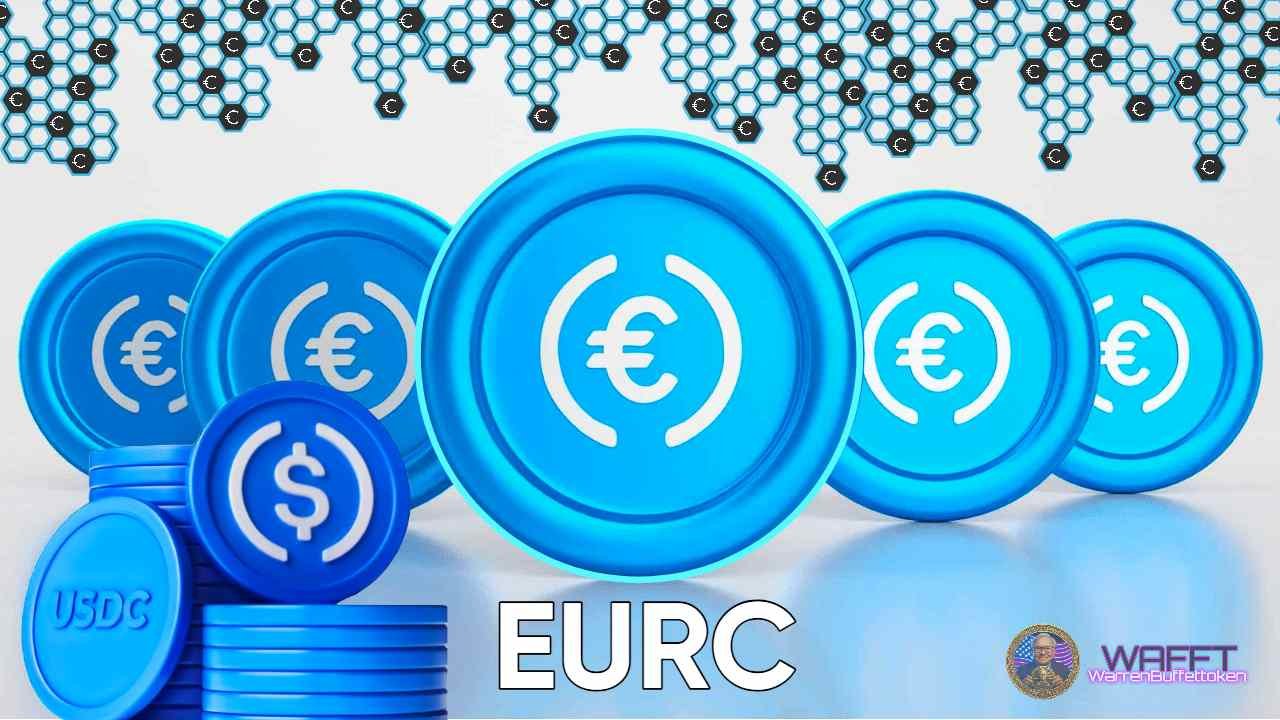
✺ Native issuance & redemption
Lives on Ethereum, Solana and Avalanche; minted and redeemed by Circle 🌐💶 — open the Circle web dashboard (official site: https://www.circle.com/euroc), wire euros from a SEPA-connected bank account, and receive EURC 1-for-1 in your wallet.
Redemption works the same: send EURC back to Circle → euros land in your bank the next business day.
Bridged copies that hop to other chains are IOUs; the true guarantee sits on the three canonical networks.
🤔 What Are "Canonical Networks"?
📦[WAFFT Explains]
The three canonical networks—where Circle mints and redeems EURC at a strict 1€ = 1 EURC rate—are:
1. Ethereum mainnet 🟠🔗
2. Solana mainnet 🟣⚡
3. Avalanche C-Chain 🔴🏔️
On any of these three you can wire euros to Circle and receive EURC—or send EURC back and get euros—directly. On every other chain only bridged “IOU” versions circulate, and they must be routed back to one of the canonical networks before they can be redeemed.
✺ Cash-only backing
Cash-only backing held at two French Tier-1 banks 🏦🔒 — every 1 EURC equals 1 euro held in demand deposits at BNP Paribas or Société Générale. No T-bills, no staking, no crypto collateral—just cash you could pull from the European banking system. Deloitte attests the balances monthly, and under MiCA the European Central Bank may audit Circle at any time.
✺ MiCA e-money approval
First euro stablecoin with full MiCA e-money approval 📜✅ — MiCA tags EURC as an “EMT” (e-money token).
Circle must: keep 100% cash reserves in the EU, allow same-day redemption, publish audited reports, and ring-fence client money in a safeguarding account—so if Circle failed, funds are legally protected and must be returned to holders.

✺ Merchant payments & hedging
Built-in use cases: payroll, checkout, EUR↔USD carry trades 🛒💼 — BitPay, Checkout.com and Shopify plugins let merchants accept EURC just like USDC; Web3 payroll apps (Superfluid, Hedgey) stream salaries in EURC, sparing EU staff FX spreads (the hidden fee in currency conversion).
DeFi traders park EURC in lending pools such as Aave or Morpho, borrow USDC and run EUR/USD carry trades—e.g., deposit €10,000 in EURC, borrow $10,000 at 4% APR, redeposit at 8% APR, pocketing the ~4% gap (note: both rates can change daily)—all while staying on-chain.
✺ Gas-saving versions on Solana and Avalanche ⛽⚡
• Solana: store EURC in a wallet like Phantom or Solflare; tapping Send to pay a €3 coffee burns about €0.0008 in fees (<€0.01) and settles in ≈0.4 s, far cheaper and faster than SEPA Instant (≈10 s, €0.10). If your EURC sits on Ethereum, you can bridge it over via Wormhole/Portal in one click for just a few cents.
• Avalanche C-Chain: Circle mints EURC natively here, so no bridge is needed—open Core or Trader Joe, swap EURC ↔ AVAX or USDC with sub-cent slippage, and the trade confirms in ~2 s. Both networks sidestep the typical €2–€5 gas you’d pay on Ethereum, making micropayments, DEX swaps and on-chain tipping practical for everyday users.
✺ Key risks ⚠️
Holding EURC is like holding cash at a bank: Circle and its custodians rely on EU banking protections; a bank failure would invoke deposit-guarantee schemes, not on-chain collateral.
Liquidity is deep but concentrated: Curve’s EURC/EURt and Binance’s EURC/USDC pairs each clear €10–15 million per day—healthy, yet far smaller than USDC’s >€500 million daily volume—so very large swaps outside Europe can move the price a few basis points.
Extras & Advanced Mechanics
✺ Circle Yield & treasury services 🌱 — firms with >€1 million can park idle EURC with Circle for short-dated euro money-market returns (~2.5% APY, variable, unsecured).

✺ Transparency portal 🔍 — real-time reserve snapshot, monthly attestation PDFs and MiCA disclosures live on Circle’s site.
✺ Strategic Innovations 🛣️ — EURC is rolling out three tech upgrades to sharpen its real-world utility:
Decentralized On-Ramps 🏧
• Open standard to swap euros → EURC in seconds, sidestepping legacy banking rails—think Apple-Pay-style flow with built-in verification.
Direct Institutional Custody 🛡️
• MPC vault integrations let enterprises mint/burn EURC without ever parking funds in hot wallets.
Native Issuance on Identity L2s 🚀
• Mint straight on scalable, KYC-ready networks, unlocking use cases like compliant remittances and regulated airdrops (WAFFTake: feels a bit too much control for our taste—but hey, it’s your money, do what you want!🫣).
Ongoing mission:
• Cut entry/exit costs
• Deliver enterprise-grade custody
• Position EURC as the go-to stablecoin for regulated DeFi
🛑 WAFFT Risk Note: lightning-fast on-ramps require strict KYC—if a provider goes offline, your EURC could be temporarily locked.
WAFFT Risk Score 🔥 1/5 — rock-solid cash reserves, MiCA licensing and top-tier banks minimise risk; trade-off: no on-chain yield beyond what DeFi can provide.
🎓 WAFFT’s Stability Playbook: Your Essential Guide
Want to know where to move your money without getting lost in complex jargon?
⬇️ Here’s WAFFT’s cheat sheet, clear and to the point:

Guide
🏦 Trading on Centralized Exchanges (CEX)
🔸 Recommended Stablecoins: USDT or FDUSD.
🔸 Why: They’re the most liquid (there are always buyers and sellers), and on Binance FDUSD pairs have zero fees, so you maximize every trade.
✨ WAFFTip: Before trading, compare the bid–ask spread 📊 so you don’t get any surprises in your balance.
💳 Payments in Online Stores
🔸 Recommended Stablecoins: PYUSD or USDC.
🔸 Why: They integrate directly with PayPal and Visa as an additional payment method; you get paid instantly and your customer doesn’t notice the difference.
✨ WAFFTip: Set up notifications on your e-commerce platform to confirm crypto payments in real time and prevent fraud 🔔.
🌎 Remittances to Latin America
🔸 King Stablecoin: USDT.
🔸 Why: It dominates OTC desks (private markets for large trades without affecting price), meaning speed and lower losses from unfavorable FX rates 💸 when sending money.
✨ WAFFTip: Choose a reputable OTC provider and review their daily liquidity history to avoid surprises 🔍.
📈 DeFi Yields Over 10%
🔸 WAFFT Options:
sUSDe (yield tokens generated by supporting the Synthetix network)
DAI Savings (auto-compounding yield system)
🔸 Why: Both offer solid interest, backed by cash and derivatives, avoiding the roller coaster of other crypto assets.
✨ WAFFTip: Check the collateralization ratio before depositing; this ensures your position stays safe during sharp market drops 🛡️.
🛡️ Censorship Resistance
🔸 Key Stablecoin: LUSD
🔸 Why: You only need ETH as collateral; no government or bank can freeze your funds, giving you full control.
✨ WAFFTip: Keep your ETH in a hardware wallet 🔐 and use a new address for each deposit to protect your anonymity 🎭.
🇪🇺 Euro Corridors
🔸 Euro Stablecoin: EURC
🔸 Why: It complies with the EU’s MiCA regulation and allows SEPA payouts in just one business day, combining speed and legality 📅.
✨ WAFFTip: Verify your receiving bank’s SEPA conversion fees to optimize the net amount arriving in your account 🏦.
⚡️ Quick Guide Rundown:
🔹 CEX Trading: USDT/FDUSD (zero fees on Binance)
🔹 E-commerce: PYUSD/USDC (instant payments via PayPal/Visa)
🔹 LatAm Remittances: USDT via OTC (high volumes with no unfavorable rate losses)
🔹 DeFi Yield: sUSDe or DAI Savings (10% + without the roller coaster)
🔹 Censorship Resistance: LUSD with ETH (total control without banks)
🔹 Euro Rails: EURC + SEPA in 24 h (legal and fast)
🎯 Ready to become a pro at financial stability and crypto? Our WAFFT Guide: The Path to Wealth gives you the keys and strategies to take control of the markets. Join the WAFFTers, follow us on social media, and stay up to date with our tips. Your time to shine has arrived! 🌟🔥💥🚀
Why Are Stablecoins Important?
🔸 Hedge Against Volatility → Park your gains in USD-pegged tokens without leaving the crypto space.
🔸 Fast & Cheap Transactions → Instant global transfers with fees often a fraction of traditional bank costs—far cheaper than SWIFT or wire transfers.
🔸 DeFi & Yield Farming → Use stablecoins as collateral for loans, LP tokens (Liquidity Provider tokens that represent your share in a liquidity pool) on AMMs (Automated Market Makers, decentralized exchanges that facilitate trading with community funds such as Uniswap, SushiSwap, and PancakeSwap), and in staking pools to earn passive income.
🔸 Fiat On-Ramps & Off-Ramps → The go-to bridge for entering or exiting crypto via exchanges, wallets, and OTC desks.
🔸 Gateway to Crypto Investments → Most newcomers buy stablecoins first, then diversify into Bitcoin, Ethereum, or other digital assets.
🔸 Remittances & Global Payroll → Send money home or pay remote teams instantly—no SWIFT fees, no long waits.
🔸 Financial Inclusion → Unbanked populations gain a fully digital “checking account” with just a smartphone.
🔸 Programmable Money → Automate subscriptions, payroll, or escrows via smart contracts—your rent paid on autopilot.
🔸 DeFi Collateral Backbone → Mint decentralized dollars (e.g., DAI) and underpin lending/borrowing protocols.
🔸 Regulatory Transparency → Real-time audits (PoR), KYC/AML compliance, and institutional integrations build essential trust.
🧘 WAFFT mantra:

"Stability is your foundation, strategy is your engine, and financial freedom is the destination" 🛠️🚀
Key Advantages & Challenges of Stablecoins
Ready to dive into the world of stablecoins? Think of them as your crypto lifeboat —steady in a stormy sea—but every ship has its leaks. 🛶
Below, we break down the 🚀 high points that make stablecoins shine and the ⚠️ rough edges you need to watch.
Advantages ✅

🏦 Stability
They offer a safe haven from the extreme volatility of traditional cryptocurrencies.
⚡ Efficiency
Transactions are near-instant with very low fees compared to traditional banking.
🌍 Mass Adoption
Accepted on exchanges, at merchants, in payment gateways, and on DeFi platforms worldwide.
🔍 Transparency
Many publish real-time audits and Proof-of-Reserves, building trust without sacrificing speed.
🤖 Programmable Money
Enable automated payments, subscriptions, and smart contracts without intermediaries.
💸 Yield Generation
Some stablecoins offer yield programs (staking, lending) above 5% APY, becoming “productive” assets.
🤝 Financial Inclusion
Unbanked populations can use a stablecoin on their mobile as their primary digital account.
Challenges & Risks ⚠️

🏦 Centralization & Counterparty Risk
You depend on the issuer managing reserves properly; if they go bankrupt or misbehave, your capital may be exposed.
📜 Regulatory Scrutiny
Governments in the U.S., Europe, and Asia are tightening AML/KYC rules and licensing for stablecoin issuers.
⚖️ Peg Depegging Risk
If reserves are mismanaged or algorithmic models fail (e.g., TerraUSD), the stablecoin can drift from $1.
🐞 Technological Failures
Smart contract vulnerabilities (especially in algorithmic stablecoins) can be exploited with severe consequences.
💧 Liquidity Fragmentation
Not all stablecoins have the same volume: some offer deep order books, while others remain confined to regional niches.
🌱 Environmental Impact
Although most operate on Proof-of-Stake chains, gas fees on PoW networks like Ethereum can make occasional use expensive.
🔄 WAFFT Rewind
Stablecoins are our crypto lifeboat—no one controls your money except you. That freedom is exactly what makes the elites and regulators sweat 😤. Now they’re eyeing stablecoins, sharpening their claws to grab a piece of the action.
Remember: keep your eyes on Proof-of-Reserves, understand who holds the freeze key, and trust your own due diligence to stay ahead of the pack.
If you value your financial freedom as much as we do, spread the word! 🗣️
👉 Tweet/X about your favorite stablecoin and why it’s your lifeboat.
👉 Tag WAFFT (@warrebuffettok) so we can follow your take.
Stay free, stay fierce! 
The Future of Stablecoins
Stablecoins are evolving rapidly, with governments, financial institutions, and crypto developers competing to shape the next generation of digital money. From state-backed Central Bank Digital Currencies (CBDCs) to hybrid stablecoins and real-world asset (RWA) integration, the stablecoin landscape is entering a new phase of global adoption and regulatory scrutiny.
Let’s explore the latest developments and the future of stablecoins. 🚀
CBDCs: Government-Issued Digital Currencies – Deep Dive 📜
CBDCs are digital currencies issued and backed by central banks, combining the solidity of fiat with the speed of electronic payments ⚡. Unlike private stablecoins, they are legal tender and are often marketed as the ultimate solution to modernize finance, improve efficiency, and expand social inclusion—an elite-backed narrative that WAFFT sees as a Trojan horse for mass surveillance and monetary control. 🔍
🔍 What Are CBDCs?
A 100% digital fiat currency, issued and guaranteed by a country’s central bank.
Designed to offer fast, secure transactions with the backing of an official currency.
🌍 Major Projects Underway
China (e-CNY): The digital yuan is already in use for retail payments, transportation, and subsidies.
India (e-Rupee): Integrated into banking services and fintech apps for B2B and P2P payments.
Bahamas (Sand Dollar): Pioneering digital cash in small islands, bringing financial services to remote areas.
Europe (Digital Euro): Continually in development, with a focus on tiered privacy and full SEPA compatibility.
USA & UK: The Fed and BoE are debating models, while fintechs explore off-chain parallel versions.
🚀 Why They Matter (WAFFT Take)
✅ Financial Inclusion: Your phone becomes your bank account, no tedious paperwork required.
✅ Efficiency & Savings: Instant transfers and reduced fees.
❌ Total Surveillance: Every centralized transaction leaves a trace for future control.
❌ Programmable Money: Automatic taxes or blocks for “non-compliance,” all with a click.
🔮 Where Are CBDCs Headed?
1. Global Interoperability: Initiatives like mBridge connect multiple CBDCs for fast, low-cost cross-border payments.
2. Programmable Cash: From time-expiring subsidies to carbon credits that unlock when ESG goals are met (Environmental, Social & Governance criteria).
3. Public-Private Models: Central banks may delegate issuance to fintech consortia, balancing decentralization with oversight.
4. Advanced Regulation: Specialized KYC/AML frameworks for CBDCs, designed to keep citizens under a controlled—but “transparent”—system.
💥 WAFFT Reflection
CBDCs are about to redefine who controls your money and how you use it. More inclusion—or more surveillance? At WAFFT, we believe the key is to stay informed and take part in shaping these currencies. Only then can we demand real safeguards and limits on the monetary big brother. 🚨💡
WAFFTers, empower yourselves with knowledge and keep control of your financial future! 
🔗 More DeFi Integration & Real-World Asset (RWA) Innovations
DeFi is evolving beyond crypto-based lending and staking, integrating stablecoins backed by real-world assets (RWAs) such as gold, stocks, and real estate.
🔸Tokenized Gold & Commodities
Some stablecoins are now backed by gold (PAXG, Tether Gold), providing a crypto-friendly way to invest in precious metals.
🔸Tokenized Bonds & Securities
Projects are developing stablecoins pegged to government bonds or stock indexes, offering new on-chain investment opportunities.
🔀 Hybrid Stablecoins: The Next Evolution?
Some developers are experimenting with hybrid models that combine fiat-backed collateral with algorithmic stabilization mechanisms.
🔸Key Examples of Hybrid Stablecoins
🟢 TrueUSD (TUSD) – Fiat Backing with Smart Contract Transparency
Backed 1:1 by USD reserves but uses real-time third-party audits for full transparency.
- Implements dynamic fee models to maintain stability and improve arbitrage opportunities.
🟣 Frax (FRAX) – Partially Collateralized, Partially Algorithmic
Uses both collateralized reserves and algorithmic supply adjustments to maintain its $1 peg.
More scalable than fully backed stablecoins, reducing dependency on traditional reserves.
🎯 WAFFT recap:
Regulators around the world are sharpening their claws—drafting stricter rules and licenses to dictate how we move our money. Yet despite every attempt at control, the march toward true economic freedom is relentless. Stablecoins continue to evolve, layering innovation on top of transparency and decentralization. The power to decide how we use and store value is now, and will remain, in our hands. Governments may try to push back, but financial liberty is on a trajectory that no decree can reverse.
👉 For those charting these waters, remember to tap into our "Google of money"—the ultimate search engine for crypto and finance—to stay ahead of the curve. 🚀
Stay free, stay informed, stay WAFFT.
The Evolution of Stablecoins – Key Insights
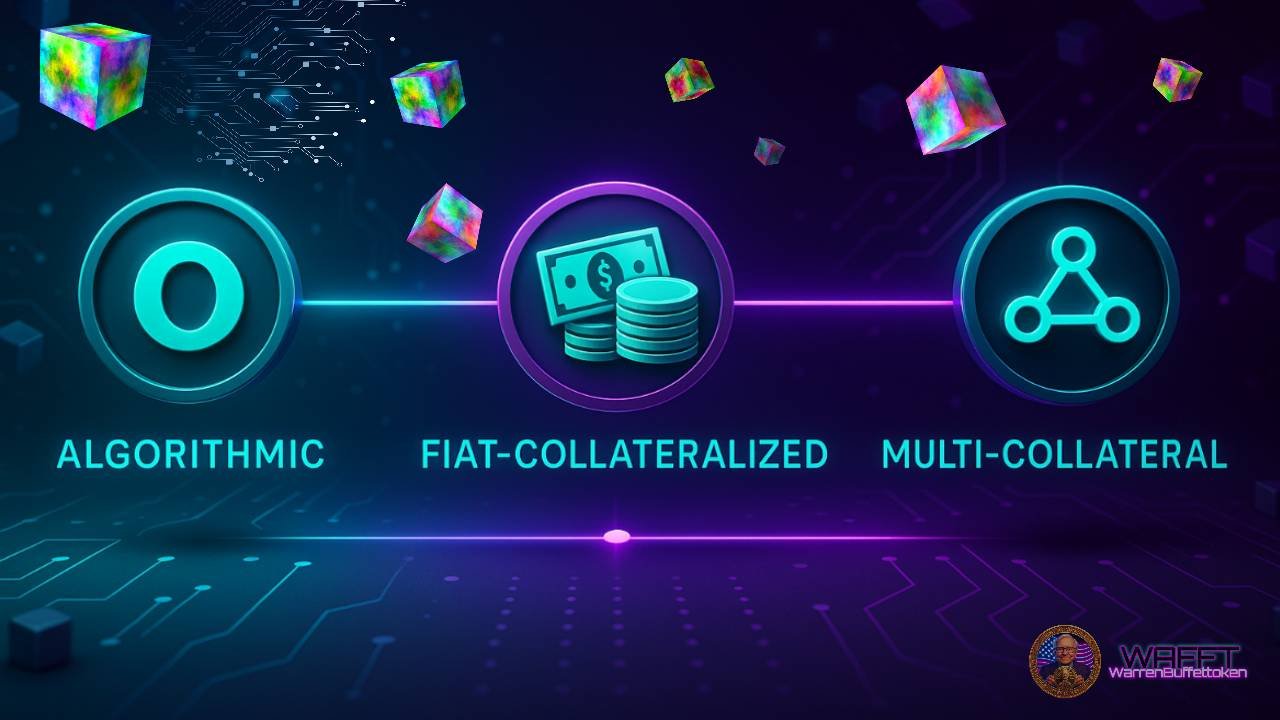
From the first dollar-pegged tokens to today’s programmable rails, here’s where stablecoins are headed. ⬇️
👥🏛️ Private vs. CBDCs
✺ Will central bank digital currencies replace private issuers or learn to share the stage?
Expect both to coexist: CBDCs will excel at retail payments and compliance, while private coins like USDT and USDC continue driving DeFi innovation and cross-border rails.
💎 RWA Integration
✺ Beyond cash and T-Bills, look for tokenized real-world assets—gold bars, corporate bonds or even fractionalized real estate—backing stablecoins. This shift adds diversification and potential yield, turning your digital dollar into a multi-asset portfolio.
🤖 AI-Driven Stability
✺ Imagine oracles feeding market data into machine-learning models that tweak fees or mint/burn supply in real time. AI-powered monetary policy could smooth out shocks automatically—think autopilot for your dollar peg.
🚀 DeFi as a Mainstay
✺ Stablecoins will remain the plumbing of permissionless finance: the go-to collateral for lending pools, the fuel for cross-chain bridges, and the payment rail for decentralized exchanges and yield farms.
🔮 WAFFT Forward
👉 Stablecoins won’t just adapt—they’ll define the next era of money. Keep your eyes on Proof-of-Reserves, hybrid models, and AI innovations, and remember: Thanks to our WAFFT guide, you’ll gain the professional-grade finance skills you need—from stablecoin mechanics and DeFi strategies to regulatory deep dives. We’ll be right by your side on the path to wealth, supporting every decision and celebrating every milestone.
🏆 Stablecoins Section Complete!
You’ve now got a full, deep-dive masterclass on stablecoins under your belt. If you’re still hungry for more, flip to the next chapter: Payment Tokens, or fire up our "Google of money" search engine. Type in anything—from inflation and GDP to memecoins—and keep leveling up your investor IQ.
See you on the path to wealth, WAFFT-style! 

Wanna explore other token types taking over the crypto world? Don’t be shy—click away!  Below, you’ll find clickable names that’ll teleport you straight to each section. Still curious or looking for anything related to crypto, traditional finance, or economics? Hit up our search bar and find everything you need to level up your knowledge.
Let’s go!